
A Children’s Day reflection on Nigeria, AI, and the generation we must not fail
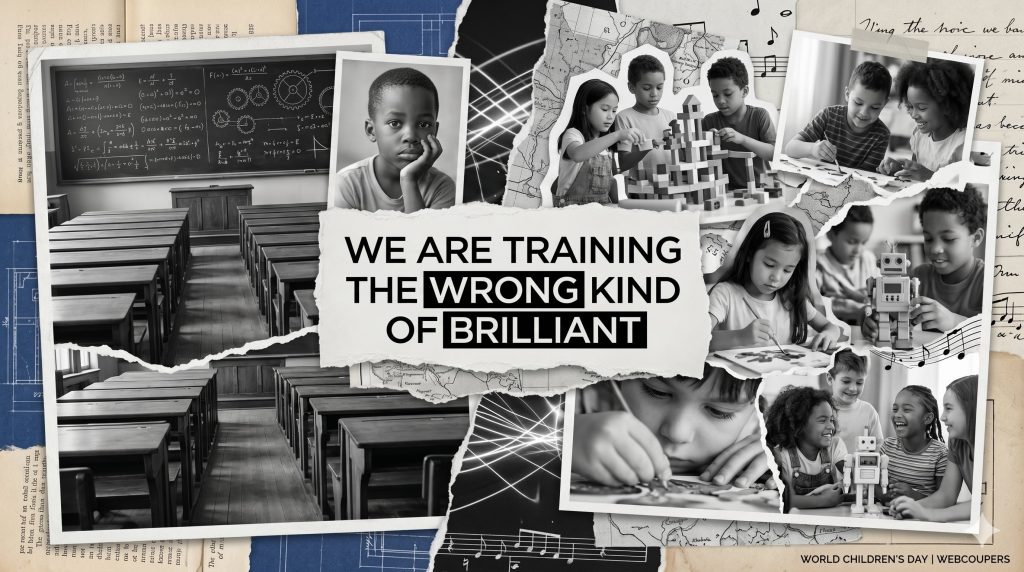
Picture a secondary school student in Surulere. She wakes before 6am, helps out with morning preparations, commutes each way, memorises twelve (sixteen to eighteen, if private school) subjects, and still finds time to read ahead. By any global measure, she is exceptional — disciplined, tenacious, mentally sharp.
Now imagine her at 22, entering a labour market where the tasks she spent twelve years training to perform — information retrieval, structured problem-solving, rote analysis — are being done faster, cheaper, and more accurately by a machine.
That is not a hypothetical. That is the trajectory we are currently on.This Children’s Day, we at Webcoupers want to say something that goes beyond good wishes: Nigeria is producing brilliant young people, and we are training them for the wrong century.
The Crucible Problem
Our educational culture has genuine strengths that the world should envy. The perseverance required to survive a demanding Nigerian curriculum, the ability to synthesise information under pressure, the resilience forged by scarcity — these are not liabilities. They are extraordinary foundations.
But foundations are not buildings.
The current model largely optimises for one outcome: passing the exam. And there is nothing wrong with rigour. The problem is what the exam measures. If success means the accurate reproduction of stored information, we are producing excellent memorisers at a moment in history when AI has made memorisation essentially worthless as a competitive skill.
The world in which our children will build their careers does not need more people who know the answer. It needs people who know which question to ask.
What AI Cannot Do (Yet)
Here is the uncomfortable truth for anyone anxious about artificial intelligence: the skills it cannot automate are the ones our schools spend the least time teaching.
AI is remarkably good at execution — retrieving, sorting, drafting, calculating. It is not good at judgment — knowing when the answer is wrong, understanding why a community in Kano would reject a solution that worked in Accra, or feeling the weight of a decision that affects real people.
The skills that will command real value in the coming decade are stubbornly human: the ability to connect ideas across disciplines, to navigate cultural nuance, to lead through ambiguity, and to think critically about the ethics of powerful tools. These are not soft skills. They are, increasingly, the only skills.
Nigeria — with its diversity of language, culture, geography, and lived experience — is uniquely positioned to produce the kind of contextually intelligent thinkers the AI economy desperately needs. That is not cheerleading. That is a structural advantage, if we choose to build on it.
The Classroom Needs a New Contract
None of this requires burning down the system. It requires renegotiating the contract between teacher, student, and knowledge.
The teacher’s role must evolve from gatekeeper of information to architect of thinking. Not because teachers are failing — most are doing extraordinary work under impossible conditions — but because AI has fundamentally changed what information costs. It is now free, instant, and infinite. What remains scarce and precious is the ability to interrogate it.
Imagine a classroom where AI handles the drilling — the grammar practice, the maths repetition, the vocabulary quizzes — and the teacher is freed to do what no algorithm can: challenge a student’s assumptions, draw out a half-formed idea, teach a child that being wrong is the beginning of understanding, not the end of it.
That classroom is not a fantasy. It is being built, in pockets, right now. The question is whether we are willing to scale it.
What This Moment Demands
Preparing Nigerian children for the age of AI is not primarily a technology problem. It does not begin with laptops or coding camps, though those matter. It begins with a decision about what we value.
Do we value compliance, or curiosity? Reproduction, or reasoning? Knowing, or questioning?
Policymakers must treat digital infrastructure — reliable internet, stable power — as the foundational utilities they actually are, not aspirational targets. Curriculum designers must make room for computational thinking, data literacy, and ethical reasoning alongside the subjects we already teach. Businesses must invest in the human capital pipeline, not just the talent we can poach from it.
And parents — perhaps most critically — must resist the instinct to measure a child’s progress only by their exam scores. The child who asks too many questions, who challenges the answer in the textbook, who cannot sit still because they are busy building something in their head — that child is not a problem. That child is exactly who this moment needs.
Children’s Day is a celebration. But the most meaningful thing we can do to celebrate Nigeria’s children is to be honest about the distance between the education they are receiving and the future they are about to inherit — and to close it, urgently, together.
The potential is already here. It has always been here.
The question is whether we are brave enough to stop wasting it.
Webcoupers builds digital products for African businesses. We believe the future of Africa’s economy runs through its people — and that investing in how we develop them is the most consequential work of our generation. Happy Children’s Day.