
What Happens When North America Actually Falls in Love With Soccer
A (hypothetical) consumer psychology look at the World Cup moment, and what it could mean if North American fandom keeps climbing toward global parity.
The Moment the Light Switched On
The 2026 World Cup didn’t just land in North America, for a fast-growing share of the population, it detonated.
Nielsen’s newest fandom research confirms the primer has been working for a while: soccer fandom across North America is up 11% from 2020 to 2025, with the region now home to more than 136 million soccer fans. The sport plays an important role in the daily lives of 60% of those fans. The World Cup itself is the accelerant on a five-year trend, not the start of one.
It’s worth being honest about where that growth actually sits today, because it’s a more interesting story than pure hype. Soccer currently ranks fourth among sports fans in the U.S. (31%) and third in Canada (37%), trailing homegrown incumbents like American football and ice hockey, while it’s unambiguously the top sport in Mexico (63%). The U.S. is already the world’s fourth-largest soccer market by fan count, at 62.5 million people. That’s real, fast-growing ground, just not full parity yet.
So here’s the question this piece is built to explore: what happens to consumer behavior if (or when) North America’s soccer adoption catches up to Europe, Africa, and Latin America , where soccer isn’t just popular, but the default sport, the default broadcast property, and the default commercial vehicle?
This isn’t a forecast. It’s a behavioral economics thought experiment built on where the sport sits today, where the trendlines point, and what we already know about how deep sports loyalties reshape markets.
Why Soccer Is Built for Psychological Lock-In
Every sport asks something different of a fan. American football asks for hours of weekly ritual and a rulebook that shifts most seasons. Basketball rewards spontaneous pickup. Baseball is generational, slow-burn patience. Soccer asks for something else entirely: ritual intensity in tight 90-minute windows.
A few structural reasons it locks fans in efficiently:
- Low floor, high ceiling. A three-year-old can kick a ball. In soccer-mad countries, elite specialization can start as early as 5–7. Compare that to American football, where safety concerns push serious training later, or hockey, where geography and equipment cost are real barriers to entry.
- Identity transfers fast. Soccer fandom can pass to kids through watching alone, no inherited lore required. A kid sees one great goal, puts on the jersey, and they’re in.
- The match itself is a ritual container. Pre-match build-up, halftime, post-match analysis, the whole thing creates a multi-hour behavioral window that naturally anchors food, drink, and apparel purchases around the fixture calendar.
And the adoption pattern isn’t uniform, it’s culturally adaptive. Mexican fans lean toward watching full matches live with family. Canadian fans favor short-form highlights and social content. That patchwork suggests each market is building its own version of fandom rather than importing one wholesale, which tends to be stickier than a single top-down push.
The FMCG Opportunity
Soccer fandom doesn’t just shift what people buy, in mature markets, it shifts when and why they buy it.
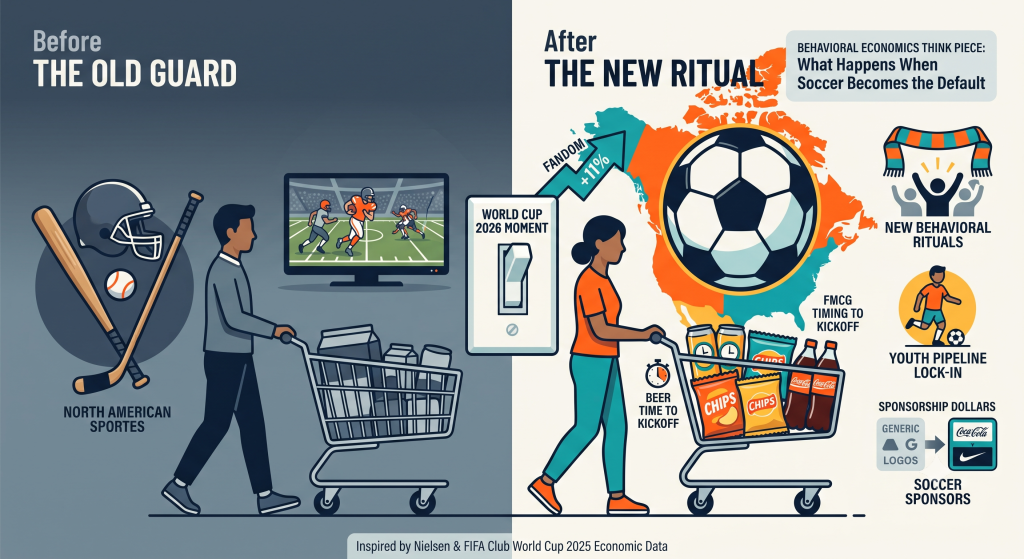
In established soccer countries, grocery and retail sales of beer, soda, snacks, and prepared food are well known to spike around kickoff times, tied to specific broadcast slots rather than just “the weekend” broadly. That’s temporal behavioral conditioning at retail scale.
In North America today, that pattern shows up occasionally, around Champions League finals, MLS Cup, or a World Cup run — rather than every week. If adoption keeps climbing toward European levels, a few things become plausible:
- FMCG promotional calendars could realign around the global soccer calendar: European weekends, midweek Champions League, the now-familiar Saturday-morning Premier League slot for U.S. viewers.
- Performance and “clean eating” nutrition brands have a natural narrative fit. Soccer’s aerobic, stop-start demands make it an easy story for functional nutrition and recovery-focused brands to tell.
For a sense of scale on what soccer’s economic footprint already looks like when a major tournament lands here: the FIFA Club World Cup, hosted across U.S. cities in summer 2025, generated an estimated $17.1 billion in gross output and contributed $9.6 billion to U.S. GDP, supporting roughly 105,000 jobs and $5.8 billion in labor income. That’s what one tournament did, a useful anchor point for thinking about what a fuller commercial ecosystem could look like.
Sponsorship: A Plausible Reallocation
North American sponsorship dollars are still heavily concentrated in the NFL, NBA, and golf, with soccer holding a smaller, but growing, slice. What makes soccer’s audience distinctive isn’t just size, it’s receptivity: Nielsen found that 73% of North American soccer fans say they find sponsors appealing, and 61% say they’d choose a sponsor’s brand over a rival’s. That’s an unusually favorable audience for brands to court, independent of any future growth story.
Soccer’s calendar is also a structural advantage on its own terms. Between MLS domestically, weekend European leagues via streaming, continental competitions like the Champions League, international windows, and the quadrennial World Cup, soccer offers a genuinely packed volume of recurring, high-attention events — more standing inventory across the calendar than most single leagues can offer.
If fandom keeps converging toward European norms, a few shifts become plausible: World Cup knockout matches involving the U.S. drawing marquee-level ratings; soccer’s community-rooted club structure making grassroots sponsorship (youth academies, local clubs) a more meaningful brand play than a stadium naming right; and rigid annual sponsorship deals giving way to more dynamic, moment-based inventory.
What Soccer Would Take From the Others
Every hour a casual fan spends on soccer is an hour taken from something else. That’s basic attention economics, and a few pressure points are worth naming:
- The NFL has the most at stake in a full-adoption world, simply on hours, its season is far shorter than soccer’s stacked league calendars. That said, Sunday’s cultural entrenchment is a real defensive moat, and this is a genuinely open question rather than a foregone conclusion.
- College sports could feel a squeeze if a generation grows up with geography-independent club loyalty rather than the four-year, alumni-driven loyalty that anchors college fandom today.
- Baseball, already skewing toward an older U.S. audience, could see further erosion among younger fans drawn to soccer’s shorter total time commitment and more condensed, plannable drama.
If soccer reached major-market share, broadcasters could plausibly restructure weekends into a “triple-header” model, Premier League early, MLS mid-afternoon, Liga MX evening. It wouldn’t be unprecedented: English top-flight football’s entire broadcast economy transformed after the Premier League’s 1992 breakaway and the Sky Sports rights deal that followed, taking the league from BBC highlights to reshaping British Sunday television. North America’s version, if it happens, would likely take longer, given a more fragmented three-country starting point.
The Youth Pipeline: Health as a Behavioral Flywheel
Soccer’s biggest edge over American football, hockey, and baseball may be structural: a lower minimum age for safe specialization.
- Football: youth leagues start around 5–6, but collision-risk concerns push serious specialization later.
- Basketball: pickup starts young, but organized travel programs are costly and elite youth burnout is a documented concern.
- Soccer: in soccer-first countries, structured training starts at 4–6, club academies around 8, professional pathways from roughly 10.
If that pattern took hold at scale in North America, the plausible downstream effects are real, if not yet proven here: more cumulative practice hours by late adolescence, earlier exposure to sports nutrition habits like hydration and recovery fueling, and, most interestingly for marketers, identity formation locked in during the exact years (6–12) when fandom tends to become permanent. A kid who falls in love with the sport during the 2026 World Cup is in their twenties by 2040, with disposable income and an established viewing ritual already built in.
The broader public-health case is a real one, if more modest than it sometimes gets made out to be: youth sport participation generally correlates with better aerobic fitness markers, and soccer’s low cost of entry relative to hockey or elite travel basketball could make it an unusually effective vehicle for that — if adoption keeps growing the way current trends suggest.
The World Cup as an Accelerant
North America has just hosted a World Cup across all three countries. The infrastructure investment behind it — stadiums, broadcast partnerships, youth registrations, club academy expansions, is the kind of spending economists call asset-specific: you can’t easily un-build a stadium or un-train a generation of coaches. That makes reversal structurally unlikely once participation crosses a certain threshold.
And the momentum is measurable, not just anecdotal: 64% of North American soccer fans expect their interest in the sport to keep growing, and 68% say their interest has already increased over just the past three years, as World Cup anticipation built.
The Bigger Picture
Run this forward as a thought experiment, not a prediction: if North America’s soccer adoption converged with Europe’s over the next decade or so, you’d expect broadcast weekends built around global soccer, meaningfully shifted youth participation patterns, FMCG calendars that mirror Europe’s fixture-driven retail rhythm, and sponsorship dollars spreading out from today’s small set of incumbent leagues.
Whether that happens, and how fast, is genuinely uncertain, and the most honest version of this story holds two things at once: real, accelerating growth (11% in five years, 136 million fans, an unusually sponsor-receptive audience) sitting on top of a starting position where soccer is still the fourth-ranked sport for U.S. fans and third in Canada. Both are true simultaneously.
What’s not in question is the mechanism. Soccer has genuine structural advantages, an early, low-cost participation pipeline, a tight ritual window built into every match, and a fan base that’s unusually open to the brands around it. Whether that adds up to the sport reshaping North American consumer behavior at scale is the open question the next decade will answer. But the foundation for it is already being poured.
Sources: Nielsen, “The Fans Behind the Game: FIFA World Cup 2026 Edition” (June 2026); FIFA Club World Cup 2025 economic-impact data, as reported alongside the same Nielsen research.